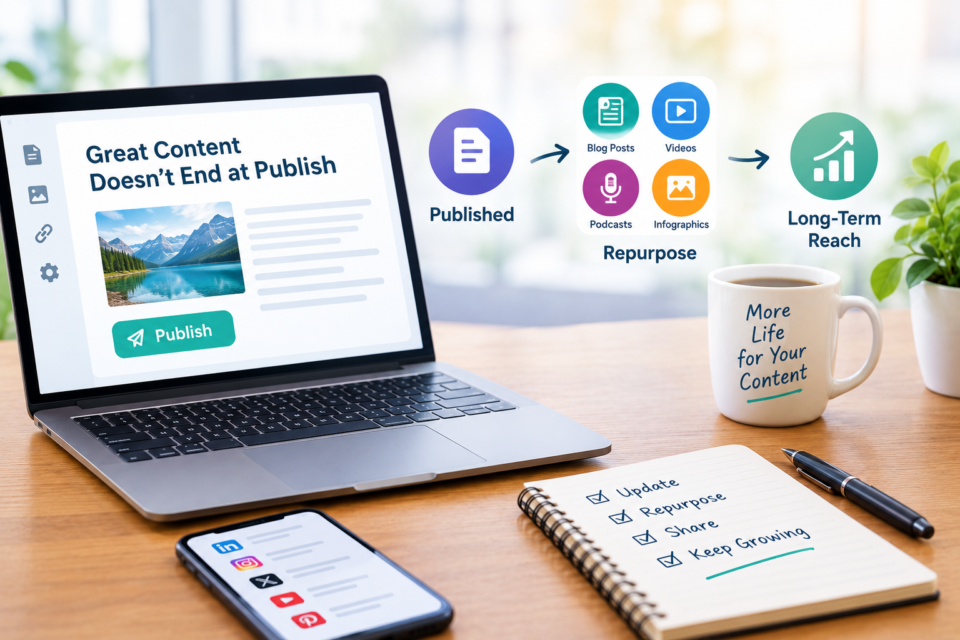
A company spends several hours researching and writing an article.
The article is edited, uploaded to the website, shared on social media and included in an email. For a few days, people visit it. Then attention moves elsewhere.
The marketing calendar demands another article.
So the process begins again.
This is how many businesses treat content: as something with a publication date and an unofficial expiry date.
But useful content doesn’t necessarily become less valuable simply because it is no longer new.
An article that attracted modest traffic during its first month might contain an idea that could generate discussion on LinkedIn six months later. A paragraph buried halfway through an old guide could answer one of the most common questions the sales team receives. A customer comment on a social post could reveal the subject of a future article.
This creates a different way of thinking about marketing: the content afterlife.
Instead of asking only how a piece of content performs after publication, businesses can ask how many useful forms that knowledge can take throughout its lifetime.
Table of Contents
Publication Should Be the Beginning, Not the Finish Line
Content calendars naturally focus on publishing dates.
Monday: blog article.
Wednesday: LinkedIn post.
Friday: video.
The calendar looks productive because something new is constantly appearing.
The problem is that production can become the objective.
Once an article is published, everyone moves on to the next item without asking whether the previous piece contained ideas worth developing further.
Imagine a Boston cybersecurity company publishing a detailed article about five security mistakes it regularly discovers during client audits.
The article itself is only one possible expression of that knowledge.
Each mistake could become a short social post. One particularly surprising finding could become a video. Questions in the comments might create an FAQ. A salesperson could use the article during a prospect conversation. Twelve months later, the company could update the piece using observations from another year of audits.
One body of knowledge can therefore produce multiple marketing assets without becoming repetitive.
Content Has Ingredients
A useful article isn’t really one piece of content.
It is a container filled with smaller ingredients.
There may be an interesting statistic, a surprising observation, an explanation, a customer question, an analogy, a practical recommendation and several examples.
Businesses often publish the container once and forget about the ingredients.
A better approach is to identify those ingredients during content production.
Suppose an architecture firm creates a 1,500-word guide explaining common mistakes businesses make when planning office renovations.
Inside that article might be one observation about meeting-room acoustics that deserves its own social discussion. Another section could answer a question frequently raised during initial consultations. A before-and-after example could become a visual post.
Breaking content into ideas makes reuse much easier than repeatedly trying to invent completely new topics.
Social Media Can Become a Testing Ground for Bigger Ideas
The relationship can work in reverse too.
Not every idea deserves a 2,000-word article.
A business may have an observation that seems interesting but isn’t sure whether customers care about it.
Social media provides an opportunity to test the idea in a smaller format.
Publish the observation.
See what happens.
Do people ask follow-up questions? Does someone disagree? Do customers share their own experiences? Does the sales team recognise the issue?
If an idea generates meaningful discussion, there may be enough substance to develop it into a more comprehensive resource.
This makes social media more than a distribution channel for website content.
It becomes a research environment for future content.
Comments Are Unpaid Content Research
Businesses frequently spend money researching what customers want to know.
Some of that information is already sitting underneath their social posts.
Comments can reveal confusion, objections, experiences and questions that formal keyword research may not uncover.
Suppose a financial company publishes a post explaining a regulatory change.
Someone asks whether the change applies to small businesses.
Another person asks what happens to existing arrangements.
A third asks how the rules affect a particular industry.
Those aren’t simply comments requiring replies.
They are evidence of information gaps.
The original social post can therefore create the brief for a deeper website article.
The audience has effectively helped determine what should be explained next.
Sales Conversations Can Give Old Content a Second Life
Some of the best opportunities for content reuse exist outside the marketing department.
Salespeople repeatedly answer similar questions.
How long does implementation take?
What does the process involve?
Why does your approach cost more?
How are you different from another solution?
What happens if something goes wrong?
If the company has already published strong content addressing these questions, sales should know it exists.
An old article with modest search traffic may become extremely valuable if it helps a salesperson answer an objection during a $50,000 opportunity.
That creates a different definition of content performance.
The page didn’t need thousands of visitors.
It needed to be useful at the right moment.
Build a Content Shelf, Not Just a Content Calendar
A calendar tells a business what it plans to publish.
A content shelf tells it what useful knowledge it already owns.
The shelf can contain evergreen guides, case studies, original observations, customer questions, research, videos, diagrams and particularly successful social discussions.
Before creating something new, marketers can search the shelf.
Perhaps an article from eighteen months ago deserves updating.
Maybe an old case study contains a lesson that was never promoted properly.
A webinar might contain ten minutes of excellent discussion that could become several smaller educational pieces.
This approach doesn’t eliminate new content creation.
It makes new creation compete with reuse.
Sometimes the most efficient next piece of content already exists in another form.
Give Every Strong Idea More Than One Format
People don’t consume information in identical ways.
One person might happily read a detailed article. Another prefers a 60-second video. Someone else notices a diagram while scrolling through a social feed.
The underlying idea can remain the same while the presentation changes.
A detailed guide might become a visual summary. A customer story can become a short video. An internal expert interview might become an article, several social posts and a sales resource.
The objective isn’t to copy and paste the same message everywhere.
Each format should be adapted to how people use that environment.
For companies investing in Content Marketing Services in Boston, this can significantly change content planning. The question is no longer simply how many new articles should be commissioned each month, but how effectively useful knowledge can be developed, distributed, tested and reused.
Let Social Reactions Rewrite Website Content
Website content is often treated as relatively permanent, while social content is treated as temporary.
The temporary content can actually help improve the permanent content.
Imagine a company publishes a short explanation from one of its service pages on social media.
Several people respond that the explanation is confusing.
Others repeatedly ask the same follow-up question.
That feedback suggests the website itself may be incomplete.
The business can improve the original page using the language and questions surfaced through social interaction.
This creates a loop:
Website knowledge creates social discussion, and social discussion improves website knowledge.
Over time, both become stronger.
Stop Forcing Every Idea Onto Every Platform
Content reuse shouldn’t mean publishing identical material everywhere.
Different platforms create different expectations.
A detailed explanation that works on a company website may need to become much shorter and more conversational on social media. A professional insight suitable for LinkedIn might not translate naturally into an Instagram post.
Sometimes the right decision is not to publish on a particular platform at all.
Businesses looking for the Best Social Media Marketing Agency near me should therefore consider more than posting frequency or the number of networks being managed. A useful social strategy should understand which ideas belong on which platforms, how audiences behave there and how interactions can feed useful intelligence back into the broader marketing program.
The objective isn’t maximum distribution.
It is appropriate distribution.
Create Content Descendants
Instead of calling reused material “repurposed content,” think of it as creating content descendants.
A descendant should inherit the strongest idea from the original while becoming useful in its own right.
Suppose a Boston engineering company publishes an article about unexpected causes of project delays.
One observation from that article becomes a LinkedIn discussion.
The comments reveal another common problem.
An engineer responds with an explanation.
That explanation becomes a short video.
Questions under the video inspire a new FAQ.
Several months later, the FAQ data is incorporated into an expanded version of the original article.
The content family has grown organically.
Each asset exists because the previous one produced information worth developing.
Give Content a Retirement Test
Not every article deserves an afterlife.
Some information becomes outdated. Some topics never resonate. Other content may have been weak from the beginning.
Businesses need a way to decide what deserves continued investment.
Before reusing an old asset, ask whether the underlying idea remains accurate and useful. Check whether customer questions have changed, whether examples are still relevant and whether new information could materially improve the piece.
Content that no longer serves a purpose can be updated, consolidated or retired.
The goal isn’t to preserve everything forever.
It is to prevent valuable knowledge from being abandoned simply because its publication date is old.
Measure More Than the First Performance
Content reporting often concentrates on what happens directly after publication.
Traffic, rankings, engagement and leads all matter.
But they don’t capture every possible return.
A useful article might later support sales conversations, generate social discussions, attract links, inspire videos, answer customer questions or provide material for a presentation.
Those outcomes can happen months after the original publication.
Businesses can therefore record where strong content is reused and what it contributes elsewhere.
A piece that initially appeared average might turn out to be one of the most useful knowledge assets the company has produced.
The Audience Can Become Part of the Editorial Team
The most interesting version of the content afterlife occurs when audiences begin influencing what happens next.
A company publishes an idea.
Customers question it.
Employees add their experience.
Someone offers a different perspective.
Sales hears a related objection.
The company responds with a deeper explanation.
Content is no longer moving in one direction from brand to audience.
It becomes a conversation that produces additional knowledge.
That approach is particularly valuable in an environment where brands can generate enormous quantities of content quickly. Publishing more is becoming easier. Producing something informed by genuine interaction remains much harder.
Stop Asking What to Publish Next
Marketing teams regularly reach the end of a month and ask:
“What should we create next?”
There may be a better question:
“What did our existing content teach us?”
Look at which ideas generated questions.
Find the articles sales teams actually use.
Review comments that exposed misunderstandings.
Identify older resources that remain relevant.
Notice which social discussions deserve deeper treatment.
The next strong content idea may not require another brainstorming session.
It may already be hiding inside something the business published six months ago.
The real opportunity isn’t simply creating more content.
It is giving good ideas enough time, formats and conversations to reveal their full value.
